
Shape the Future of the Electric Grid

Join the GridWise Architecture Council – Now Accepting Candidate Submissions

The GridWise Architecture Council is seeking visionary leaders to help guide the future of the nation’s electric grid. Formed by the U.S. Department of Energy, GWAC members shape frameworks for grid interoperability, resilience, and transactive energy. Candidates should be recognized experts in fields like grid architecture, utility operations, distributed energy, or policy. Members serve as individuals, not company reps, and commit 5–20% of their time to this impactful work.

Final submissions due by: January 16, 2026

What is the GridWise Architecture Council?

The GridWise Architecture Council (GWAC) is a team of industry leaders who are shaping the guiding principles, or architecture, of a highly intelligent and interactive electric system—one ripe with decision-making information exchange and market-based opportunities. This architecture will provide guidelines for interaction between participants and interoperability between technologies and systems.

How can I get involved with GWAC?
Interested in helping shape the vision for a decarbonized, decentralized, and democratized electricity system? We'd like to connect with you! Please email us to attend the GWAC Meeting (gridwiseac.coordinator@pnnl.gov). All are welcome.

Upcoming Events

Event Logo / Image
Image
RE+ logo

RE+ Las Vegas - GWAC Tutorial

November 17, 2026 - November 17, 2026

Event Description

Title: SEPA GWAC Workshop
Date: Tuesday, November 17, 2026
Time: 1:00pm to 5:00pm
Meeting Room:  W213 
Location: Las Vegas Convention Center

GWAC Workshop Tutorial registration is now open! Agenda in development.

GWAC presents, “The New Energy Landscape”
This tutorial offers an accessible, systems of-systems introduction to the rapidly evolving energy landscape. Participants will explore how customer owned technologies such as inverter-based resources, EV charging infrastructure, controllable loads, and automation enable dynamic grid interactions. The tutorial examines critical cross sector dependencies across transportation, communications, natural gas, and the electric grid, helping attendees understand how modernization decisions in one domain influence resilience and performance in others. Finally, we discuss the operational and governance frameworks needed to coordinate a decentralized grid, highlighting accountability structures, and scalable approaches to balancing physical, economic, and cybersecurity constraints.


Event Logo / Image
Image
GWAC symposium logo

GWAC Symposium

March 16, 2027 - March 18, 2027

Event Description

** SAVE the DATE **

Hello GWAC, GWAC Associates & Emeritus and Friends - 

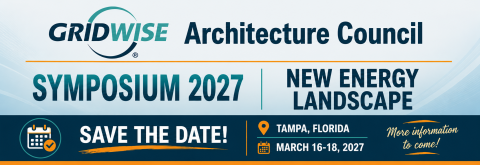
Please mark your calendar for the GWAC - GridWise Architecture Council Symposium, taking place March 16-18, 2027, in Tampa, Florida.

This symposium will bring together members of the GridWise Architecture Council and stakeholders to collaborate, share insights, and discuss the future of grid architecture and modernization.

Additional details, including the agenda, registration information, hotel accommodations, and travel logistics, will be shared in the coming months.

We look forward to seeing you in Tampa!

The GWAC Symposium Planning Team 

Upcoming Monthly Meetings

GWAC Monthly Face to Face Meeting in Las Vegas

November 16, 2026 - November 18, 2026

Event Description

November 16 at 9:00am to 5:00pm (Pacific Time)
November 17 at 8:00am to 12:00pm (Pacific Time)

GWAC Guest Speaker: Alaa Mahjoub (presenting virtually)
Date: November 16, 2026
Time: 10:00am local time

A Reference Architecture for RAG-Based Digital Grid Operational Decision Support

Integrating Operational Context and Engineering Knowledge for Evidence-Grounded Insights and Action Recommendations

Abstract
This presentation introduces a RAG-based reference architecture that integrates real-time operational context, asset and network information, and engineering knowledge to support digital-grid operations. It presents the context-modelling and knowledge-preparation pipeline, layered architecture, and event-driven workflow, illustrated through a transformer thermal-event use case. Governance, human oversight, and future multimodal extensions are also discussed.